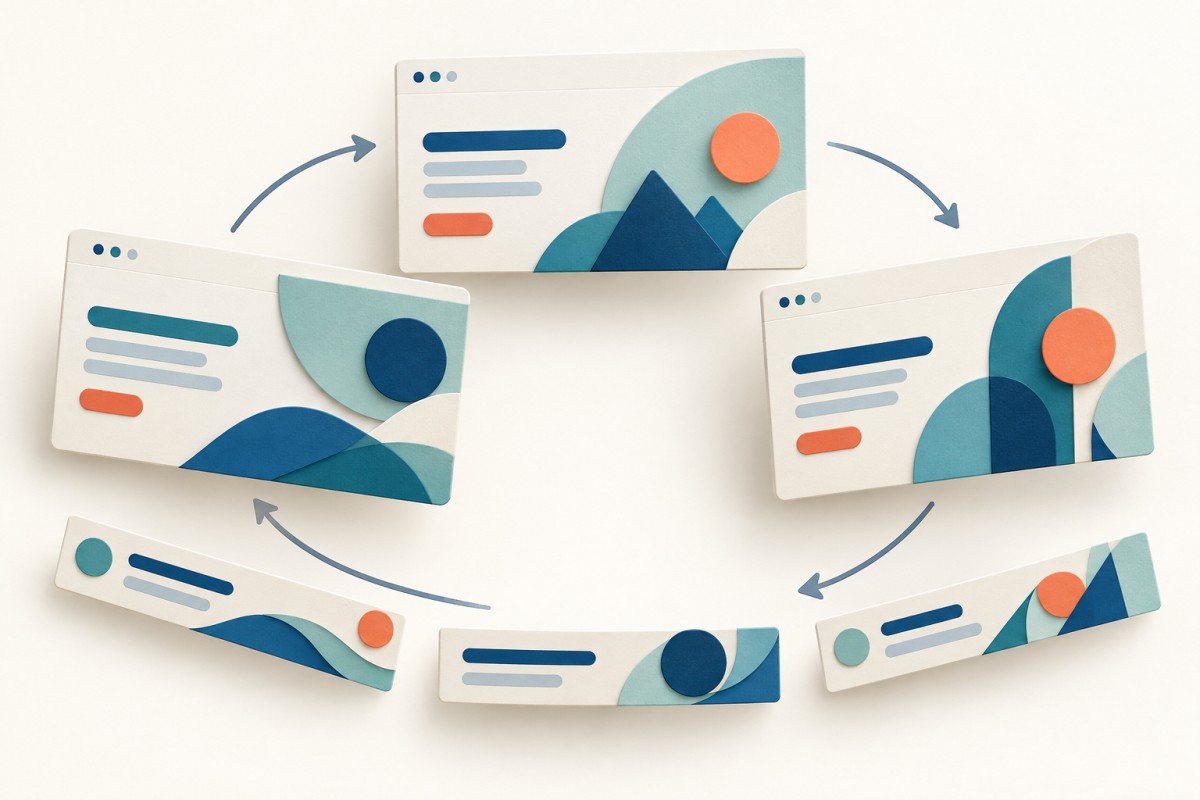
Traffic exchange advertising works best when people can recognize your message across repeated exposures. A familiar name, visual style and promise help connect one visit with the next. Yet an advertisement can eventually become easy to overlook. The aim of splash page advertising and banner rotation is to refresh the presentation while preserving the identity people are learning to recognize.
You do not need to replace every creative on a schedule. Build a small, controlled rotation, define a useful outcome and let the evidence guide your next change.
Why repeated exposure matters
A visitor may notice your colors on one viewing, remember your name on another and explore your offer later. Consistent cues give those separate exposures a connection. Recognition is useful, but it does not automatically create trust or sales: your offer and destination still have to deliver what the advertisement promises.
Choose a few elements to keep steady: your business name, a simple visual identity, your main colors, your tone and the core benefit. Your traffic exchange banners and splash pages can use different layouts while sharing those cues.
Give each advertising format a clear job
A banner should communicate one benefit quickly. Check it at its actual display size, with readable wording and a clear invitation. A splash page can explain a little more, but it should still have one main headline, a concise explanation and one obvious next step.
Match the promise across the banner, splash page and destination. If a banner offers a beginner’s promotion checklist, the page should immediately confirm that offer. Avoid a rotation that sends visitors to unrelated offers under the same design.
Rotate variations around a stable baseline
Start with two versions: your baseline A and one challenger B. Change one meaningful variable, such as the headline’s benefit angle, the main illustration or the call to action. Keep the brand cues, offer, destination and other elements steady.
For example, a checklist campaign could compare “Organize Your Website Promotion” with “Plan Your Next Ad With a Simple Checklist.” Both versions can keep the same colors, name, illustration and button. That gives you a specific question to answer: which headline attracts more useful responses?
When testing banners, keep the destination page stable. When testing splash pages, keep the incoming creative and traffic source as comparable as practical. If your tools support balanced exposure, use it. Otherwise alternate comparable periods and note that timing and audience changes can affect the comparison.
Recognize creative fatigue without guessing
Being tired of seeing your own ad is not proof that visitors are tired of it. A declining response rate can suggest fatigue, but first check for a broken link, slow page, changed placement, different audience or an offer that no longer matches the destination.
Review on a regular cadence that fits your traffic volume. A weekly review can help organize the work, but low-volume tests may need longer. There is no universal number of days or impressions that makes a result conclusive.
Refresh one angle when you have a reason to test it. Keep a successful baseline running while you introduce a challenger. Save previous versions and their results so you can revisit a useful creative rather than rebuilding from memory.
Judge performance by the next useful action
Decide your goal before the test: confirmed subscriptions, relevant inquiries or another concrete action. Record reported impressions, measured visits and completed goals separately. Page displays, clicks and conversions describe different stages, and the reporting systems may define them differently.
Give each creative a simple ID and record its start date, placement, destination and changed variable. Use creative-level reporting or campaign attribution on pages you control when available. If you cannot attribute goals to each version, acknowledge that limitation rather than pretending a total proves which ad performed better.
Suppose A receives 1,000 reported impressions, 30 measured visits and three confirmed subscriptions, while B receives 1,000 impressions, 40 visits and two subscriptions. B earned more visits, but A produced more subscriptions in that small test. Neither result is strong proof on its own. Repeat a fair comparison before making a major decision, and consider the time, credits or money required.
Apply the routine on SurfAholics TE
You can use SurfAholics TE to put a consistent advertising routine into practice. Prepare matching splash pages and banners, check the current advertising rules and available formats, and use the reporting provided for your placements. Keep your own campaign record alongside it so website traffic can be reviewed in context.
Begin with one offer and a manageable amount of exposure. Keep your baseline recognizable, introduce one challenger and review comparable results. Do not assume the exchange automatically runs a controlled test for you; use the rotation and reporting options actually available in your account.
A practical rotation checklist
- Write down the brand cues and promise that remain fixed.
- Choose one useful goal and one variable to test.
- Create A and B with matching branding and a consistent destination.
- Check links, readability, loading and desktop/mobile presentation.
- Record exposure, visits, goals and advertising effort using consistent definitions.
- Keep the best supported baseline and introduce a new challenger only when you have a clear question.
Effective banner rotation adds freshness without erasing recognition. Keep the familiar identity, test deliberately and let meaningful responses guide your next improvement.